

About Us
Empowering innovation across sports excellence and personalisation.
- 27 Lichfield Road, Dagenham, England, RM8 2AT
Managing multiple brands within a single business introduces hidden operational and strategic challenges. Multi-brand operations require careful coordination, clear positioning, and strong systems to effectively drive growth opportunities.
Having multiple brands under one business helps target different audiences and increase market presence. This also leads to increased complexity in decision-making, resource allocation, and brand management. This blog explores the challenges businesses face and shares practical insights from real-world experience.
A multi-brand operation is a business model in which a single company manages multiple brands under its umbrella. Each brand has its own identity, target audience, and positioning.
The multi-brand strategy allows organisations to operate multiple brands under a single structure while serving diverse customer needs. It is a key part of brand portfolio management in which businesses oversee and grow multiple brands under one company without losing their distinct value. The multi-brand model is commonly used across industries such as retail, hospitality, education, and consumer goods.
One of the main reasons companies adopt a multi-brand strategy is market segmentation. The multi-brand approach helps businesses cover a wider market. This ensures each brand speaks directly to its intended customers without creating confusion.
For example, companies may run separate brands for premium and budget offerings or create niche brands for specific customer groups. This allows them to compete in multiple segments while maintaining clear differentiation between their offerings.
Using a multi-brand approach helps with risk diversification and market share expansion. If one brand underperforms, others can continue to generate revenue, reducing overall business risk. At the same time, managing multiple brands allows companies to capture a larger portion of the market and compete more effectively.
Managing multiple brands under one company introduces several overlapping challenges that affect operations, marketing, data, and leadership. These challenges are often interconnected, which makes it important to approach them with clarity and structured systems. The following are the common challenges:
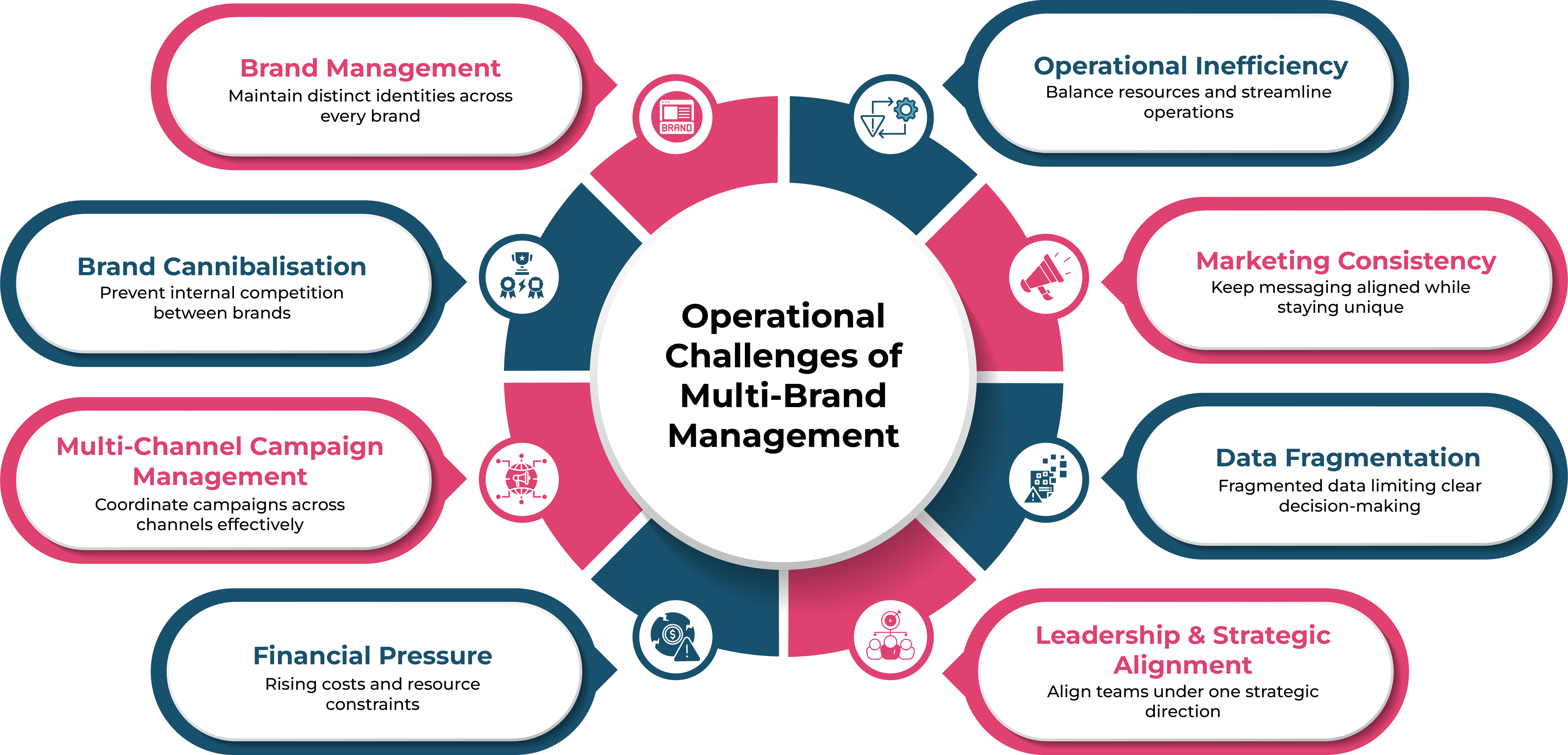
Each brand must have a distinct voice, positioning, and message. When multiple brands are handled together, it becomes difficult to maintain clear differentiation, especially if they operate in similar markets. Without strong guidelines, messaging can overlap, making it harder for customers to understand what each brand stands for.
This confusion might weaken brand value. A lack of clear identity may also affect marketing effectiveness, as campaigns fail to create a strong, unique impression in the market.
Some brands might demand more resources within a single company, while others may not receive enough support, leading to a performance imbalance. Managing these allocations becomes increasingly complex as the number of brands grows. Operational inefficiencies arise when systems are not standardised. Without clear processes, teams may duplicate efforts or struggle to coordinate tasks, wasting time and reducing overall productivity.
When multiple brands offer similar products or services, they can start competing with each other. This internal competition, known as brand cannibalisation, can reduce overall profitability rather than increasing market share. Clear positioning is necessary to define each brand's role. Without it, pricing conflicts and overlapping offerings can confuse customers and weaken the company's overall market strategy.
Maintaining consistency while keeping each brand unique is a constant challenge. Brands need to align with the company's overall direction but still communicate in their own tone and style. This balance is difficult to achieve, especially when multiple teams are involved. If not managed properly, marketing efforts can become inconsistent or repetitive.
Running campaigns across multiple platforms for several brands increases complexity. Each brand may require a different strategy, audience targeting, and content approach, making campaign management more demanding. Tracking performance for each brand separately also becomes challenging. Without proper systems, it is difficult to measure results accurately and optimise campaigns effectively.
Data is often spread across different systems, tools, and teams when managing multiple brands. This fragmentation makes it difficult to get a clear, unified view of performance across the entire brand portfolio. Inconsistent metrics and KPIs add another layer of complexity. Decision-making can slow down due to multiple stakeholders, and without aligned data, strategies may lack clarity and direction.
Managing multiple brands increases costs in areas such as marketing, staffing, and operations. Each brand may require its own resources, which can put pressure on budgets. Scaling becomes challenging when resources are limited. Some brands may grow faster than others, creating an imbalance and making it harder to maintain consistent performance across the portfolio.
Strong leadership is essential to keep all brands aligned with the overall business strategy. Without clear direction, different brands may move independently, creating confusion and inefficiency.
Defining roles, responsibilities, and decision ownership is also critical. When leadership is unclear, decision-making slows and accountability declines, affecting both short-term execution and long-term growth.
Multi-brand operations can create strong growth opportunities, but they also bring hidden complexity across operations, marketing, data, and leadership. Success depends on how well a business maintains clarity, coordination, and consistency across all its brands. The key is to learn from these challenges and build structured systems that support long-term stability. With the right strategy, discipline, and leadership, multi-brand businesses can grow sustainably while maintaining strong individual brand identities.