Visionary Leadership
Leadership Role in Scaling Ambitious Teams
- StriveX Ventures
- 16 / 03 / 2026
Leadership provides clear direction and builds a strong system capable of scaling an ambitious team. It develops a team capable of handling greater responsibilities. Effective leaders ensure that the team’s growth improves overall performance.
Team expansion brings its own challenges, and leaders must be prepared for the complexities of communication, coordination, and performance expectations. A leader guides the transition from a small team to a larger one by setting a clear vision, establishing a reliable system, and supporting employees as their responsibilities expand.
Why Leadership Is Critical When Teams Begin to Scale?
When teams begin to scale, strong leadership helps manage the growing complexity that comes with expansion. As the number of people and responsibilities increase, communication needs to become more structured and purposeful. Leaders play an important role in ensuring that information flows clearly across the team while being coordinated effectively. By setting clear expectations and defining roles, leaders help team members understand how their work contributes to the organisation's wider goals.
Leadership also protects clarity and culture as new people join the team. A leader reinforces shared values, standards, and priorities so that growth does not dilute the team's identity. This kind of guidance supports sustainable growth, maintains productivity, and enables ambitious teams to scale with confidence.
What Six Qualities a Leader Must Have to Scale a Team Efficiently?
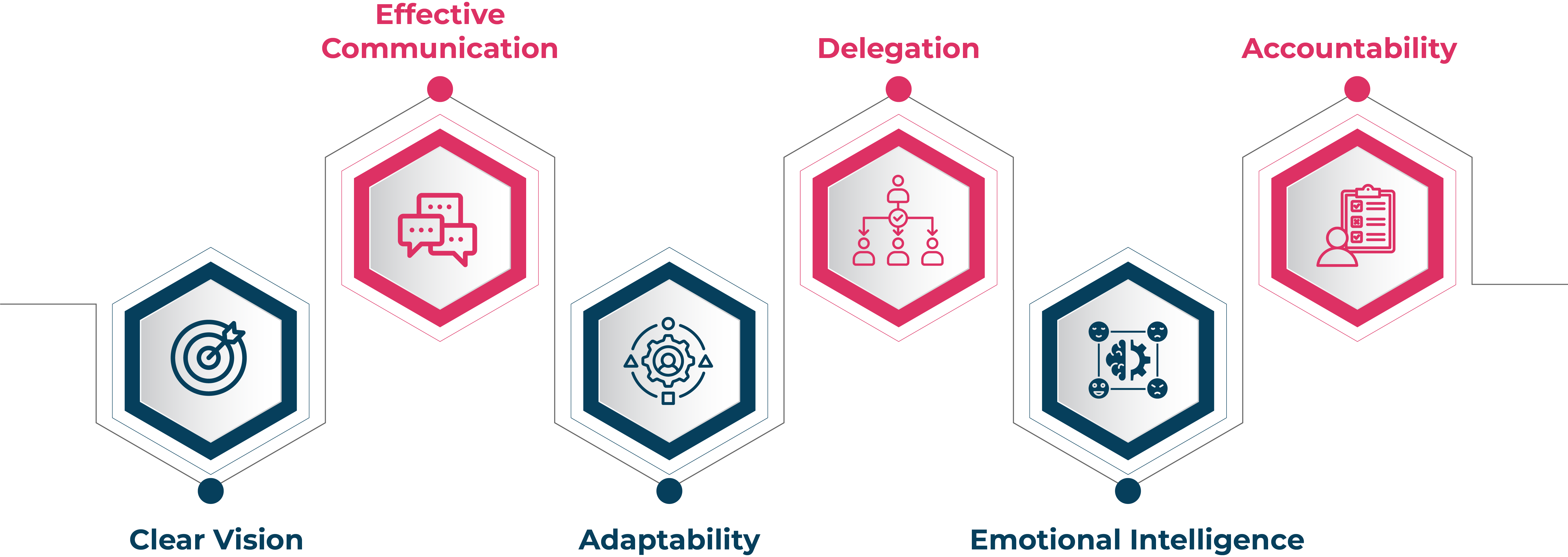
Scaling a team requires more than just expanding numbers. The right leadership qualities enable leaders to keep their teams motivated. Effective leaders demonstrate a clear vision, effective communication, adaptability, delegation, emotional intelligence, and accountability so that the team does not lose focus or cohesion.
1. Clear Vision
A leader needs a clear vision that outlines the team's goals and long-term objectives. The leader must clearly define what success looks like and set measurable goals so that team members understand where their efforts are going. This clarity is especially important during growth phases, as scaling can create uncertainty or misalignment without a shared objective.
A compelling vision also inspires the team, creating a sense of ownership and motivation that drives productivity. Leaders can assess opportunities and challenges against the team’s long-term goals, ensuring every step contributes to sustainable growth.
2. Effective Communication
Effective communication ensures understanding and collaboration. Leaders must articulate expectations, provide constructive feedback and actively listen to their team. As teams expand, the risk of miscommunication increases, making transparent communication essential for maintaining efficiency and alignment at all levels.
Communication also builds trust and connection. Leaders who openly share updates, challenges, and successes create an environment where team members feel informed and valued. Regular check-ins and collaborative discussions prevent confusion and ensure everyone moves together toward shared goals.
3. Adaptability
Scaling a team inevitably brings unforeseen challenges, from shifting priorities to evolving team dynamics. Adaptable leaders can respond to these changes without losing focus. They stay flexible, adjust strategies quickly, and embrace new processes or tools that help maintain productivity while supporting growth.
Adaptability sets the tone for the team. Teams feel encouraged to innovate, experiment, and develop creative solutions when leaders demonstrate openness to change. This culture of flexibility makes the scaling process smoother and more sustainable.
4. Delegation
Effective leaders assign responsibilities based on skills and strengths, empowering team members to make decisions and take ownership of their work. This develops leadership qualities within the team and boosts their confidence.
Proper delegation frees the leader to focus on strategy and high-level priorities. By trusting the team with operational tasks, leaders ensure that work continues efficiently, deadlines are met, and the organisation can scale without bottlenecks.
5. Emotional Intelligence
Emotional intelligence (EI) allows leaders to understand and manage both their own emotions and those of their team. Leaders with high EI can navigate conflicts, offer empathetic support, and maintain morale even during challenging periods. This quality becomes increasingly important as teams grow, and interpersonal dynamics become more complex.
EI helps recognise team members' strengths and struggles, enabling leaders to provide guidance tailored to individual needs.
6. Accountability
Accountability ensures that leaders and team members take responsibility for their actions and results. Leaders set standards, monitor progress, and address issues promptly, creating a culture where everyone understands their role in achieving outcomes. This approach keeps performance consistent and reliable.
Moreover, when members see a leader consistently upholding standards and acknowledging mistakes, they are more likely to follow suit. This creates a professional, responsible culture that drives collective success, reinforces expectations, and supports sustainable growth.
Case Study
Satya Nadella became CEO of Microsoft in 2014. At that time, the company had limited innovation and a rigid work culture. Nadella shifted the company's direction by clearly defining a new vision focused on cloud computing and a growth mindset. This encouraged the teams to learn, experiment, and collaborate. This change in vision sparked alignment across the organisation.
Nadella's leadership emphasised transparent communication, empathy, support, and adaptability. He broke down barriers and created a culture where taking calculated risks and learning from failures was encouraged. These leadership qualities helped Microsoft scale its engineering and product teams efficiently, leading to remarkable growth in areas like Azure cloud services and innovation pipelines. The company's renewed performance and internal cohesion show how strategic leadership can transform a large team's capability while maintaining focus on organisational goals.
Ventures That Lead the Way
Explore the ventures we have elevated to create lasting value.
Discover Our Ventures
Conclusion
Scaling a team successfully demands intentional, strategic leadership. Leaders who combine vision, communication, adaptability, delegation, emotional intelligence, and accountability create a structure where teams can grow without losing focus or cohesion. Strong leadership ensures that responsibilities are managed efficiently and the team's culture and alignment with organisational goals are protected.