Strategic Partnerships
Strategic Partnerships as a Growth Engine
- StriveX Ventures
- 05 / 03 / 2026
When organic growth slows and markets become crowded, many organisations reach a ceiling they cannot break alone. Organisations working alone on their growth and expansion face limited reach and higher costs. Strategic partnerships offer a way to expand reach, share capabilities, and unlock growth that would otherwise take years to achieve. They help businesses collaborate with aligned partners to access new markets, share mutual expertise, reduce risks, and strengthen their value proposition.
Strategic partnerships will move beyond short-term collaborations when they are structured to benefit in the long run. They become growth engines that accelerate expansion and create opportunities that would be difficult to achieve independently. In an economy shaped by interconnected ecosystems, a partnership strategy is a deliberate, scalable approach to sustainable business growth.
What Are Strategic Partnerships in Modern Business?
A strategic partnership is a structured approach that enables long-term collaboration, where two or more organisations share common objectives and commit resources to achieve mutual growth.
It is a transformational relationship that fosters high-trust, lasting collaboration, mutual value creation, shared risk, and aligned goals, bringing sustainable growth and innovation. The focus is on long-term strategic direction. Both parties invest time, expertise, and reputation because their success is interconnected.
Types of Strategic Partnerships
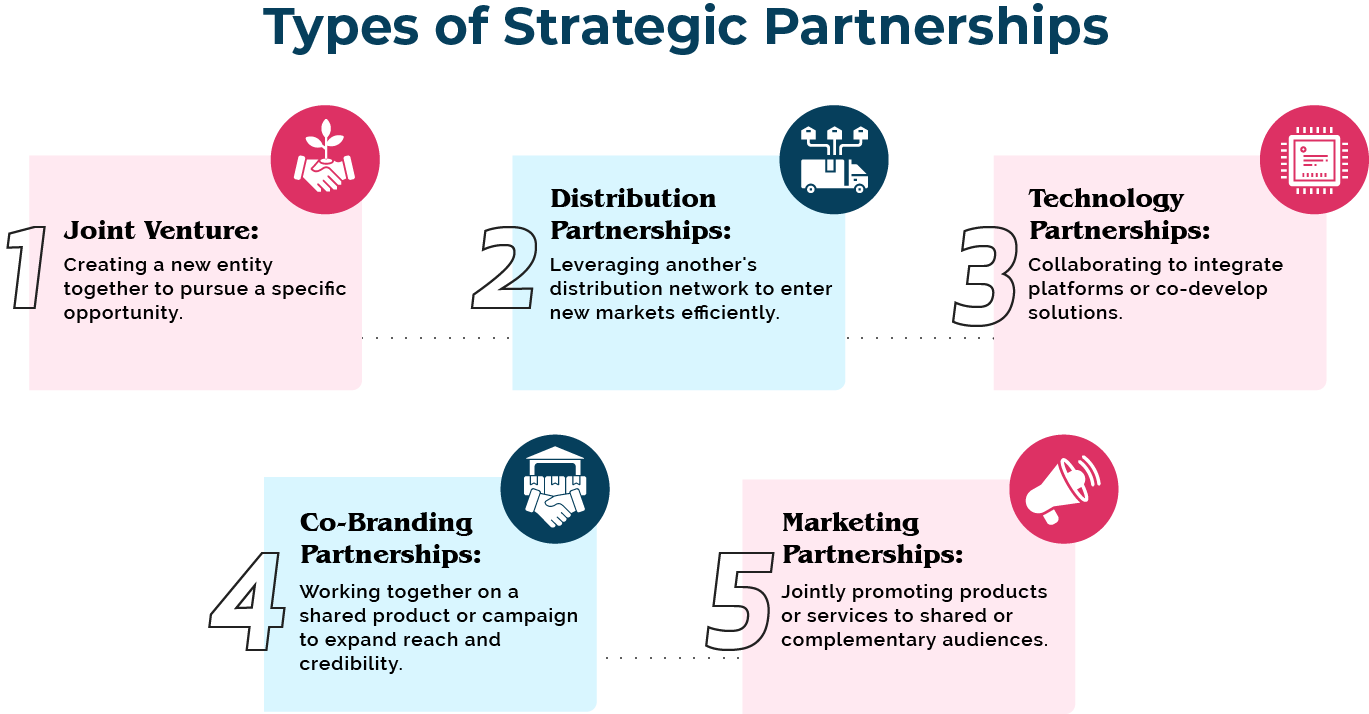
Strategic partnerships can take several forms depending on growth objectives:
-
Joint Ventures: Two organisations jointly create a new entity to pursue a specific opportunity. A well-known example is Sony Ericsson, formed by Sony and Ericsson in 2001 to combine expertise in consumer electronics and telecommunications.
-
Distribution Partnerships: One company leverages another's distribution network to enter new markets efficiently. For example, PepsiCo partnered to distribute Starbucks' ready-to-drink coffee beverages through its established retail network.
-
Technology Partnerships: Companies collaborate to integrate platforms or co-develop solutions. For instance, Nokia and Microsoft partnered to combine Microsoft Azure cloud services with Nokia's industrial private 5G networks, creating solutions for industrial IoT and automation.
-
Co-Branding Partnerships: Two brands collaborate on a shared product or campaign to expand reach and credibility, such as Nike and Apple’s collaboration in fitness technology.
-
Marketing Partnerships: Organisations jointly promote products or services to shared or complementary audiences. These partnerships may include co-hosted events, bundled offers, referral programmes, affiliate marketing, or shared digital campaigns. A strong example is Spotify and Starbucks, which combined the in-store experience with curated playlists and cross-promotion to enhance customer engagement.
Why Strategic Partnerships Are Becoming Central to Growth Strategies?
Modern markets are interconnected and fast-moving. Building every capability internally requires time and capital that many organisations cannot afford. Strategic partnerships allow businesses to:
- Expand into new regions without heavy upfront investment.
- Accelerate innovation by combining complementary expertise.
- Reduce operational and financial risk.
- Strengthen brand credibility through association.
- Adapt faster to industry shifts.
- Access specialised skills and technologies that would be costly to develop in-house.
- Shorten time-to-market for new products and services.
- Improve operational efficiency through shared infrastructure or systems.
- Increase customer acquisition through shared audiences and referral ecosystems.
- Enhance data sharing and market intelligence for better decision-making.
- Improve supply chain resilience through diversified partnerships.
- Create bundled or integrated solutions that increase customer value.
- Strengthen bidding power for large contracts through combined capabilities.
- Enter regulated or complex markets with local expertise and compliance knowledge.
- Increase competitive positioning by forming strategic alliances rather than competing alone.
- Enable scalable growth without proportionally increasing fixed costs.
Unlock Player Perks and Growth
Join the StriveX Community and get access to rewards, updates, and opportunities to elevate your game.
Join the Community Now
What Makes a Strategic Partnership Successful?
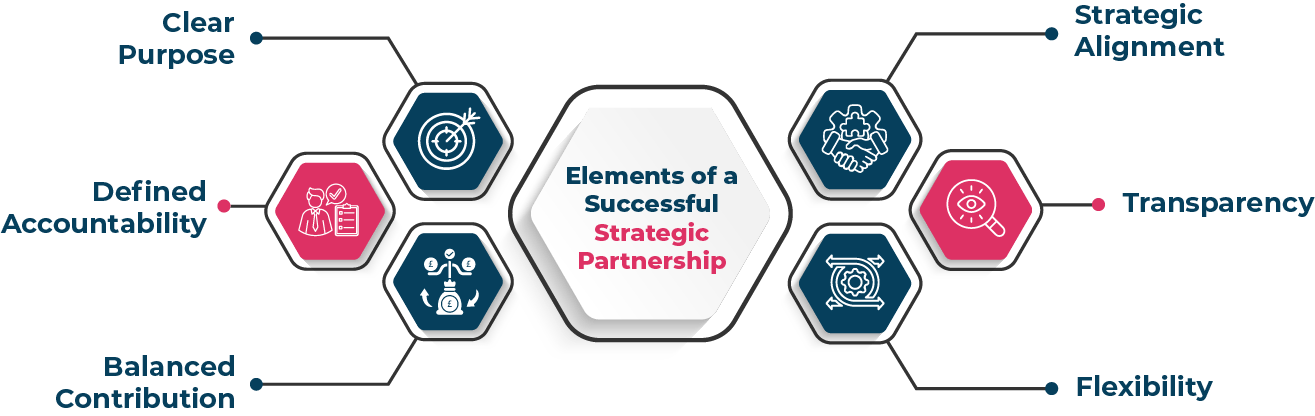
A strategic partnership does not succeed simply because two organisations sign an agreement. It succeeds because both parties remain aligned, accountable, and committed to shared progress. The following elements form the foundation of a strong and sustainable partnership.
1. Clear Purpose
Every successful strategic partnership begins with clarity. Both partner organisations must understand why the partnership exists and what success looks like, such as aiming to enter a new market, co-develop a product, or expand brand visibility.
When objectives are clearly defined and measurable, decision-making becomes easier. Misunderstandings are reduced when both parties work toward the same outcomes.
2. Strategic Alignment
A partnership may look good on paper but fail in practice if its values and working styles clash. Strategic alignment ensures that both organisations have compatible long-term ambitions. To make this relationship work, it is important that teams communicate effectively and operate with similar standards of professionalism, ethics, and customer focus. With compatible alignment, collaboration feels natural, and progress becomes steady.
3. Defined Accountability
Each organisation in the partnership must know its responsibilities, decision-making authority, and expected contributions. Clear governance structures prevent duplication of effort and reduce conflict. When roles are defined early, accountability becomes straightforward. Everyone understands who leads, who supports, and how performance is evaluated.
4. Transparency
Strong partnerships rely on consistent communication. Regular updates, shared reporting, and honest discussions about challenges build trust over time. Transparency also means addressing problems early rather than avoiding difficult conversations. Small issues handled quickly prevent larger disputes later.
5. Balanced Contribution
A partnership must feel fair to both sides. If one party consistently contributes more resources, effort, or expertise without equivalent benefit, dissatisfaction develops. Sustainable partnerships create balanced value. Both organisations should see measurable gains, whether financial, reputational, operational, or strategic.
6. Flexibility
Strategies evolve, and the market changes accordingly. A successful partnership allows room for adjustment without weakening the relationship. Flexibility ensures that both parties can adapt objectives, processes, or scope when needed. At the same time, long-term commitment builds stability. Strategic partnerships are not quick wins; they are growth frameworks that mature over time.
Case Study: How the Starbucks and PepsiCo Partnership Scaled Global Distribution?
One of the most referenced examples of a strategic partnership driving large-scale growth is the collaboration between Starbucks and PepsiCo.
Background of the Partnership
In the 1990s, Starbucks had already built a strong retail presence through its coffee shops. Its expansion into ready-to-drink beverages at a global scale would have taken years and significant capital to develop internally. For this purpose, Starbucks needed manufacturing capacity, bottling expertise, and an international distribution network.
Starbucks formed a strategic alliance with PepsiCo, a company with deep expertise in beverage production and global distribution, rather than building its own distribution system from scratch.
Strategic Structure
The partnership led to the creation of the North American Coffee Partnership (NACP), combining:
- Starbucks' brand strength and product innovation
- PepsiCo's manufacturing capabilities
- PepsiCo's established global supply chain and retail distribution network
Growth Impact
This partnership allowed Starbucks to:
- Enter the ready-to-drink (RTD) beverage market quickly
- Scale internationally without heavy infrastructure investment
- Increase brand visibility beyond physical stores
- Diversify revenue streams
Today, Starbucks ready-to-drink products are sold globally in supermarkets, convenience stores, and vending channels. This would have been difficult to achieve independently within the same time frame.
Collaborate to Elevate Your Brand
Become a strategic partner in the StriveX Championship and gain exposure, recognition, and growth opportunities through collaboration.
Partner with StriveX
Conclusion
Strategic partnerships have become a defining driver of sustainable business growth in competitive markets. Organisations that attempt to expand alone often face higher costs, slower innovation cycles, and limited reach. In contrast, partnerships allow businesses to combine complementary strengths, share calculated risks, and access markets that would otherwise require significant time and capital. Businesses that treat strategic partnerships as long-term frameworks position themselves for resilient, scalable expansion.